Reinventing Maze’s
enterprise offering
Maze, a leading product in the research space. It’s aiding professionals—designers, researchers, and product managers—in conducting both moderated and unmoderated testing. Maze current positioning is “a continuous product discovery platform that empowers teams to gather customer insights and make data-informed design and product decisions through various testing methods and AI-powered tools.”
With a three-tier pricing system in place, Maze found itself at a crossroads.
The challenges
Selling its highest-tier pricing plan was proving difficult due to a lack of compelling differentiation.
With its current feature offering it was unable to compete with larger competitors in the space as it wasn’t supporting key research methods and was lacking features in place to meet enterprise customer needs
It had very ambitious revenue goals to be able to sustain growth and its existence really. And the overarching hypothesis was that self-serve business from individuals and SMBs is unlikely to tip the scale. Also with big competitors in the space owning a large share of larger companies, it needed a competitive advantage.
So the company started evolving its value proposition from rapid research to continuous product research. But it also meant it had to fill in the gaps. What is it that Enterprise customers want and need really?
Objective
High-level metric
Our pod took on the initiative to enhance the differentiation of Maze's Enterprise pricing plan, ensuring it was tailored to the unique needs of the enterprise clientele we were looking to attract.
Increase the number of won opportunities to our Organization plan by making the product more “enterprise-ready”.
IDEAL CUSTOMER PROFILE (ICP)Enterprise companies(> 500 employees) AND within Target Verticals (Financial Services, Insurance, Tech)
Gathering Insights
Our first step was a deep dive into the feedback loop. We began by reviewing the feature requests made by enterprise teams. This analysis revealed some common themes, pointing towards enterprise customers' needs:
Minimizing regulatory and security risks
Increasing control and accountability
Using scalable processes and tools
Amplifying research capabilities
To gain a holistic view, we collaborated with Sales and Customer Success teams.
Analyzing close-lost sales data and assessed the Monthly Recurring Revenue (MRR) against feature requests provided rich insights.
Reviewed conversations our customer-facing teams had with some of our biggest clients which granted us an understanding of their research processes.
HYPOTHESISEnterprise teams prioritize control over sensitive data access and seek products that support efficient growth at scale, especially given the larger infrastructures of these companies.
Validation
To ensure we were on the right track, we surveyed our Go-To-Market (GTM) team and reached out to 30 of our enterprise clients. The feedback was resounding and confirmed our hypothesis.
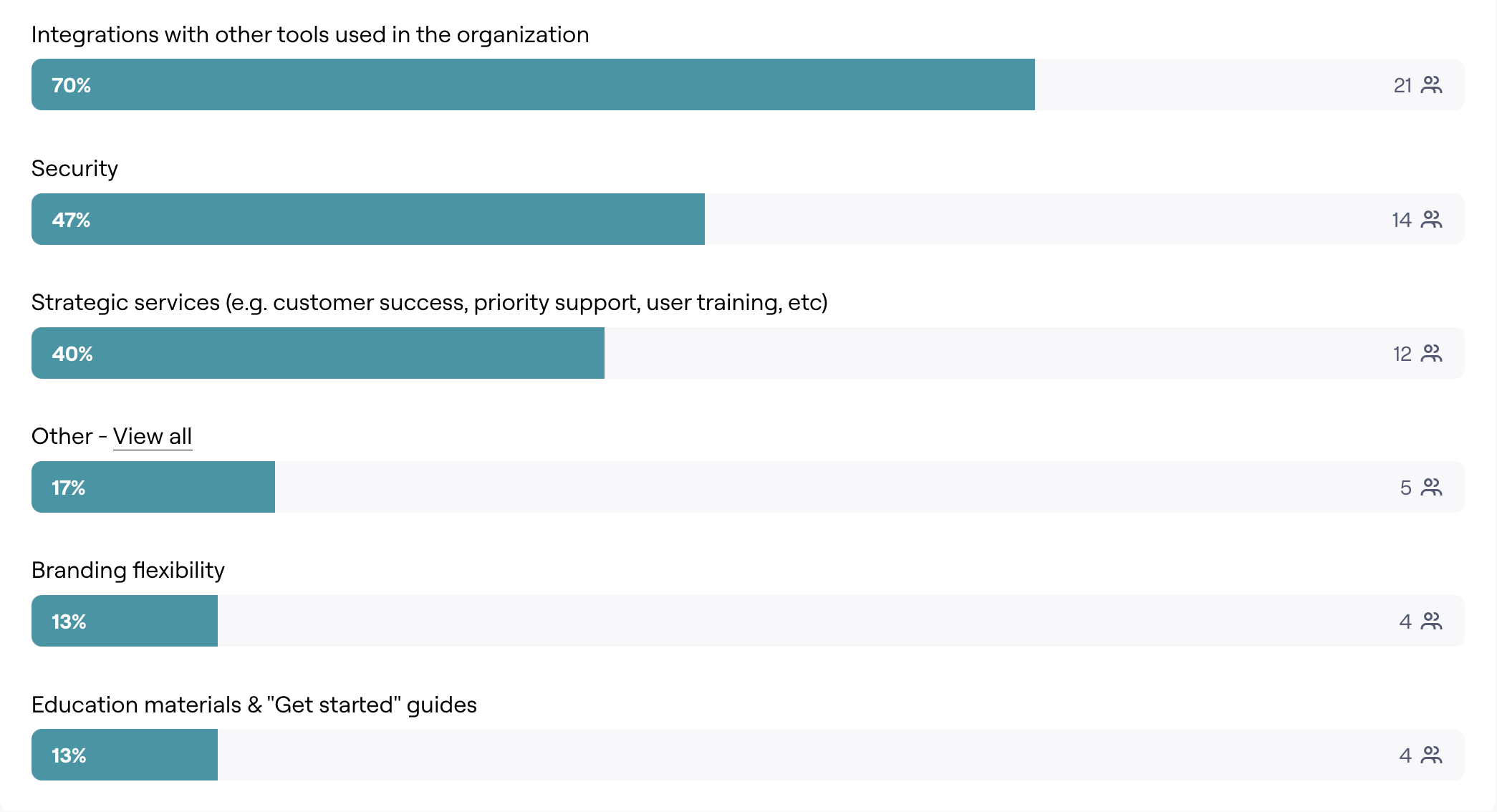
As we've gotten bigger customers and are targeting the largest enterprise orgs, this will continue to be more and more important.
Vimeo, for example had ~110 users on one org account, and it was very difficult for them to all work in one workspace, with only 1 level of hierarchy to organize (i.e. Project folders).
Another example is BCP - they have 62 seats on their account and they've set over 500 mazes live. There was also a support issue in August because their 100s of projects were not loading for them.
Having better RBAC and team organization it tablestakes for most large companies - they simply expect it.
Solution brainstorming
Through collaborative ideation, we weighed the potential impact of each solution against its implementation effort, ensuring our strategies would be both impactful and feasible for Maze.
HOW MIGHT WE
ensure teams are functioning efficiently at scale
HOW MIGHT WE
provide more levers for control and monitoring to our customers to ensure only relevant parties have access to sensitive data
Narrowing down the solutions
Context
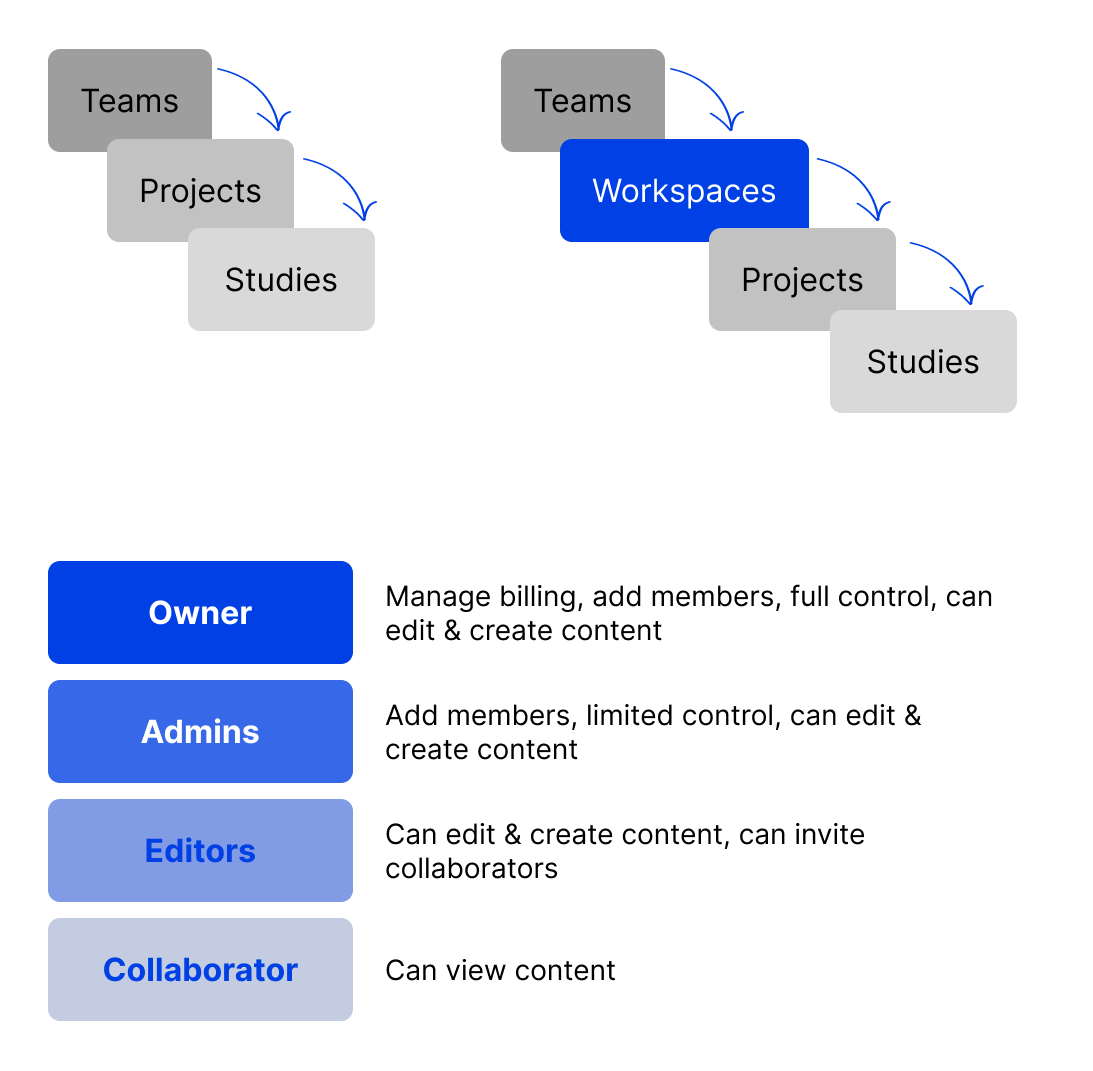
We chose to concentrate on the concept of "Workspaces" or sub-teams, combined with role-based access controls, to bolster security.
Solution validation
We then went on to validate the idea paired with some early concepts in low-fidelity of how workspaces can be layered onto our current infrastructure. And the feedback was overwhelmingly positive.
Participant feedback
It would be great to have folders, our space is already messy and we've only been using Maze for a short time!
It seemed much easier to find teams and navigate through the different projects. It's very similar to other tools like Figma, so felt much more familiar
I was just thinking about organizing the projects by teams and it's great to see it in the works! Wonderful job :)
Organization of the content through workspaces and projects, including user permissions is much improved!
Seems like a decent piece of functionality to introduce to large research orgs.
Scope
Product, Design and Engineering got together and we made further progress in refining our solution, diving deeper into its specifics.
We benchmarked against tools our customers frequently use, pinpointing key functionalities that we had to include in the initial scope which were also necessary for it to function.
This approach was shaped by our customers’ perceived mental models.
Functionality
Public workspaces
Ability to create, delete, rename workspaces accessible by everyone on the team to cater for collaboration & non-security oriented customers
Private workspaces
Ability to create, delete, rename workspaces accessible by only certain members on the team to cater for privacy and security needs
Member management
Ability by team owner and admins to add and remove certain members onto the workspace.
Convert a public workspace to a private
Also we needed a way to convert a public workspace to a private one and vice versa as we started development with public workspaces as private workspaces was more complex from engineering stand point and this way we could get initial feedback.
Moving projects between workspaces
We also delivered a way to move projects between workspaces which had to be in place for our existing customers to organize their space. We obviously needed to layer on permissions per role on who is able to do that.
Release plan
Release MVP(public) to a Beta of 10-20 customers
Gather feedback from the Beta
Use direct customer feedback to analyse if we need to make any further improvements to the implementation
Private reports
Restricting editors
Role-based access controls enhancements
Key outcome of this initiative was laying down the foundations for further and more robust role-management & permissions.
We utilized OpenFGA, an authorization solution that allows developers to build granular access control using an easy-to-read modeling language and friendly APIs. Which allowed us to later on put in place additional controls on reports and revamp our role permissions.
Private reports
Reports on studies in Maze were open to absolutely anyone with a link. The work we did allowed us to have reports private to workspace or team therefore prohibiting sensitive information to be distributed by everyone outside of the org.
Member management & additional restrictions
Allow team owner and admins to restrict editors from inviting collaborators and changing report privacy.
Success criteria (KPIs)
30% of Organization-tier teams operating in the Tech, Insurtech or Fintech sectors have adopted RBAC on workspaces (i.e. have created at least 1 private workspace with 2 projects in it)
Follow up with our customer-facing teams on current state of security in maze. Continue building a backlog of features we can build.
Outcome
Adoption was slow initially, but picked up quickly after that. With one Enterprise team creating 17 workspaces.
We managed to reach our initial adoption goals and to this day retention is high for a non-core feature directly related to our value metrics.
Post release of public workspaces
Post release of public workspaces
(within 6 months)
Last 90 days (02 March 2024)
Post release of public workspaces
(past year)
Informed roadmaps
We shared discovery findings with other pods and it was able to inform their roadmap by shedding light on ongoing issues and educate them on Enterprise teams’ needs.
What followed
Workspaces and role-based access controls was not going to move the needle. It did set the basis for how we address security & access within the product. It opened the door to continue looking into role permissions and role management.
Pricing model & value metric revision
The project was followed by a revision of our pricing and feature mapping across tiers thus digging deeper into the enterprise plan’s differentiation.
We revised our value metric to be aligned with the value customers were getting from Maze (studies & reports).
My role there was to revise the proposals from biz-ops and create an experience which was clear to the customer [To be released]
Approval of studies before their set live
We will soon use the baseline we have in place to allow for studies to be reviewed by members before their set live which would not be possible without the work we’ve done with Role-base access in the past.
[to go into discovery]
Product-led growth
There is no visibility of some of the leader enterprise features on our Free plan to the point where they are not present in the experience at all.
There is also no way to properly experience them or at least get a glimpse.
Currently looking at how we can showcase these features for Free teams and experimenting with sandbox[released] & a freemium trial experiences. [To be released]
We did get to >$900 in revenue
With workspaces and other enterprise readiness initiatives we managed to increase Average sale price (ASP) from 25K to 35K and it’s on an upwards trajectory.
Revenue at the time was at 10M, and now up to 13M.